
Metallized CPE Film — Cast PE Metallizing
Vacuum metallized CPE (cast PE) film: 40–80 µm, OD 2.3, WVTR 2.1 g/(m²·24 h). PET, CPP and OPP run on the same line. Request a sample roll.
- CPE first · PET / CPP / OPP also
- WVTR 2.1 g/(m²·24 h) on 40 µm CPE
- In-house vacuum metallizing
- Optical density 2.3
Overview
Vacuum metallizing deposits a layer of aluminium — measured in nanometres, not microns — onto the surface of a base film under high vacuum. The result is a film that blocks moisture, oxygen and light, at a fraction of the thickness and cost of foil, with no meaningful change to the film’s mechanical handling. Metallized film is the same material you were already running, with the barrier problem solved.
OLUNRO metallizes CPE (cast PE) as its main substrate and supplies finished rolls to converters and to brands buying directly. PET, CPP and OPP run on the same line as secondary options. The aluminium layer is deposited, not laminated, so the roll remains a single film — it prints, laminates and seals on the machinery you already have.
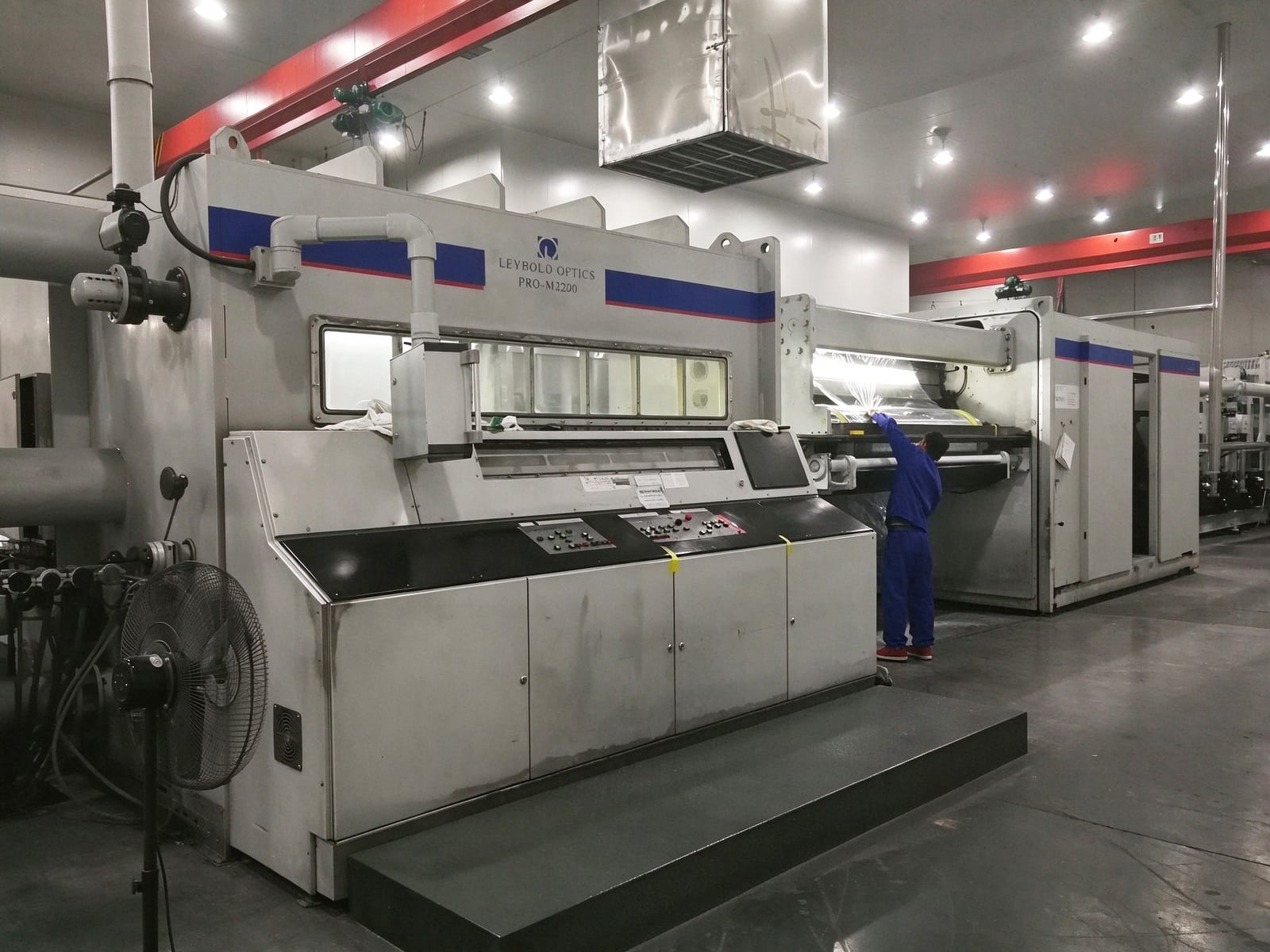
Aluminium deposited on our own line
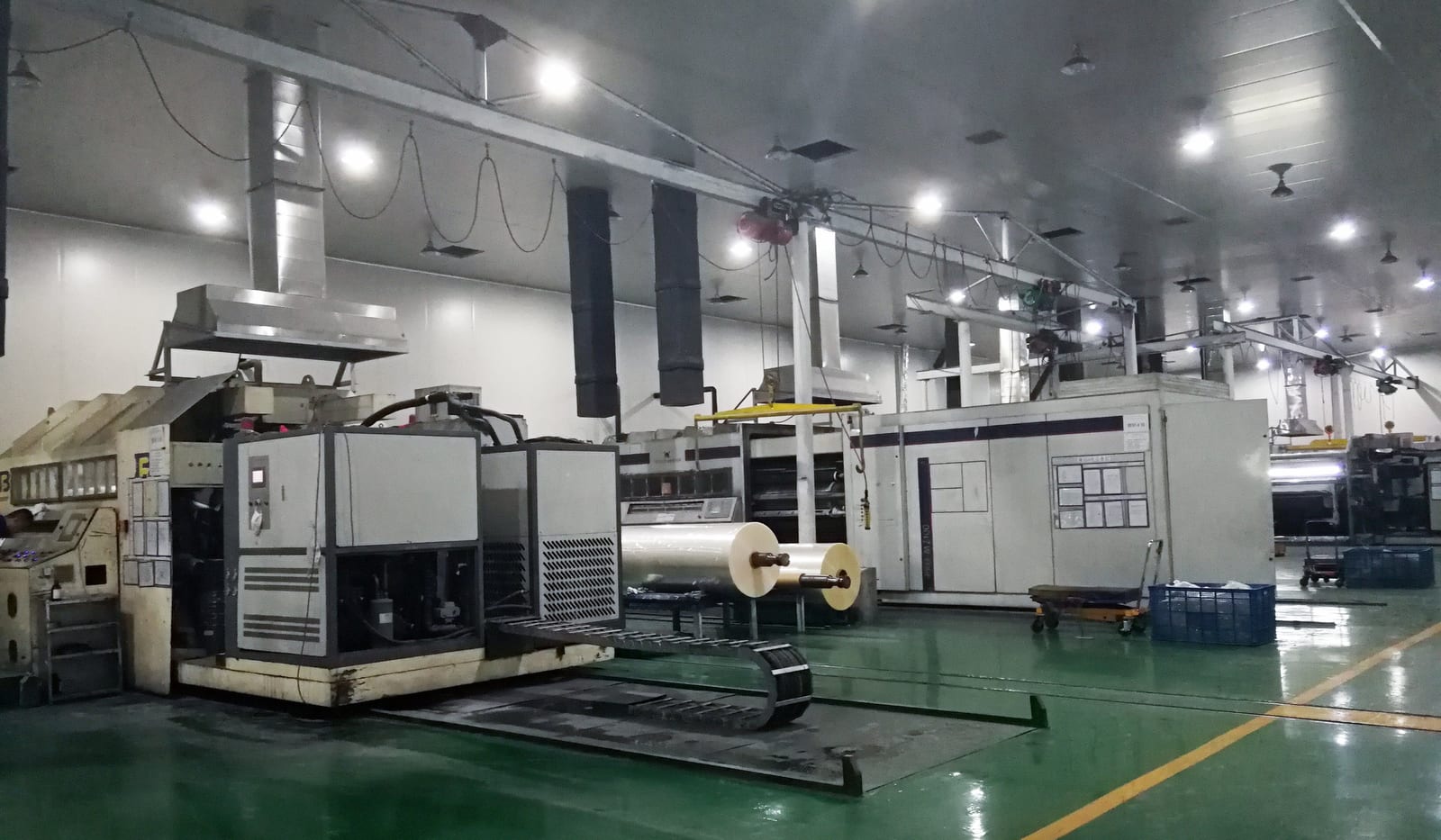
A Leybold PRO-M2200 vacuum metallizer deposits the aluminium layer directly onto the base film. Deposition, slitting and lamination run on the same site, so a substrate change is a scheduling decision rather than a new supplier qualification.
- CPE, PET, CPP and OPP metallized under one roof
- Barrier measured as optical density (OD 2.3)
- Trial rolls before volume
CPE first, then the secondary substrates
Metallized CPE (cast PE) — our main substrate. Cast PE from 40 to 80 µm (40 µm is the thinnest we metallize), optical density 2.3, WVTR 2.1 g/(m²·24 h) measured on 40 µm film at 21–30 °C and 40–70 % RH, web widths up to 3,200 mm. Metallizing cast PE keeps the structure inside one polymer family, which is what makes the mono-material route work; the ply design, the low-temperature limits and what the structure gives up are set out in our VMPE structure guide.
Metallized Polyester (VMPET) — secondary. The default choice for high-barrier laminates where shelf life is the governing constraint: excellent moisture and oxygen barrier, high tensile strength, wide temperature range and a clean surface for printing.
Metallized Polypropylene (VMCPP) — secondary. Usually selected as the inner sealing web of a two-ply laminate. Good moisture barrier, low seal-initiation temperature, and economical.
Water Vapour Transmission Rate: what metallizing actually buys you
(PET, CPP and OPP values as published on our previous site, at 40 °C — they are not comparable with the CPE figure above, which is measured in-house at 21–30 °C. See the note below the table.)
| Material | Thickness (µm) | WVTR before metallizing g/(m²·24h) @ 40 °C |
WVTR after metallizing g/(m²·24h) @ 40 °C |
|---|---|---|---|
| PET | 12 | 40 – 45 | 0.3 – 0.5 |
| CPP | 25 | 10 – 15 | 1.0 – 1.5 |
| OPP | 20 | 5 – 7 | 0.8 – 1.2 |
PE is not in this table, and that is deliberate. Polyethylene is the one substrate we metallize and measure in-house, so its figures come with a named gauge and a named test condition — you will find them on the VMPE page, not here. Putting an unqualified historical figure next to a measured one is how the wrong film gets specified.
Read the PET row instead. A 12 µm PET film transmits 40–45 g/m²·24h on its own; after metallizing it drops to 0.3–0.5. That is a reduction of roughly two orders of magnitude in a single processing step, on the same film, with no added ply.
That is the whole commercial case for metallizing: you are buying a barrier upgrade, not a new material.
Note on the numbers. WVTR figures are substrate- and process-dependent. Use this table to understand the order-of-magnitude gain, then ask us for measured data on the exact structure you plan to run.
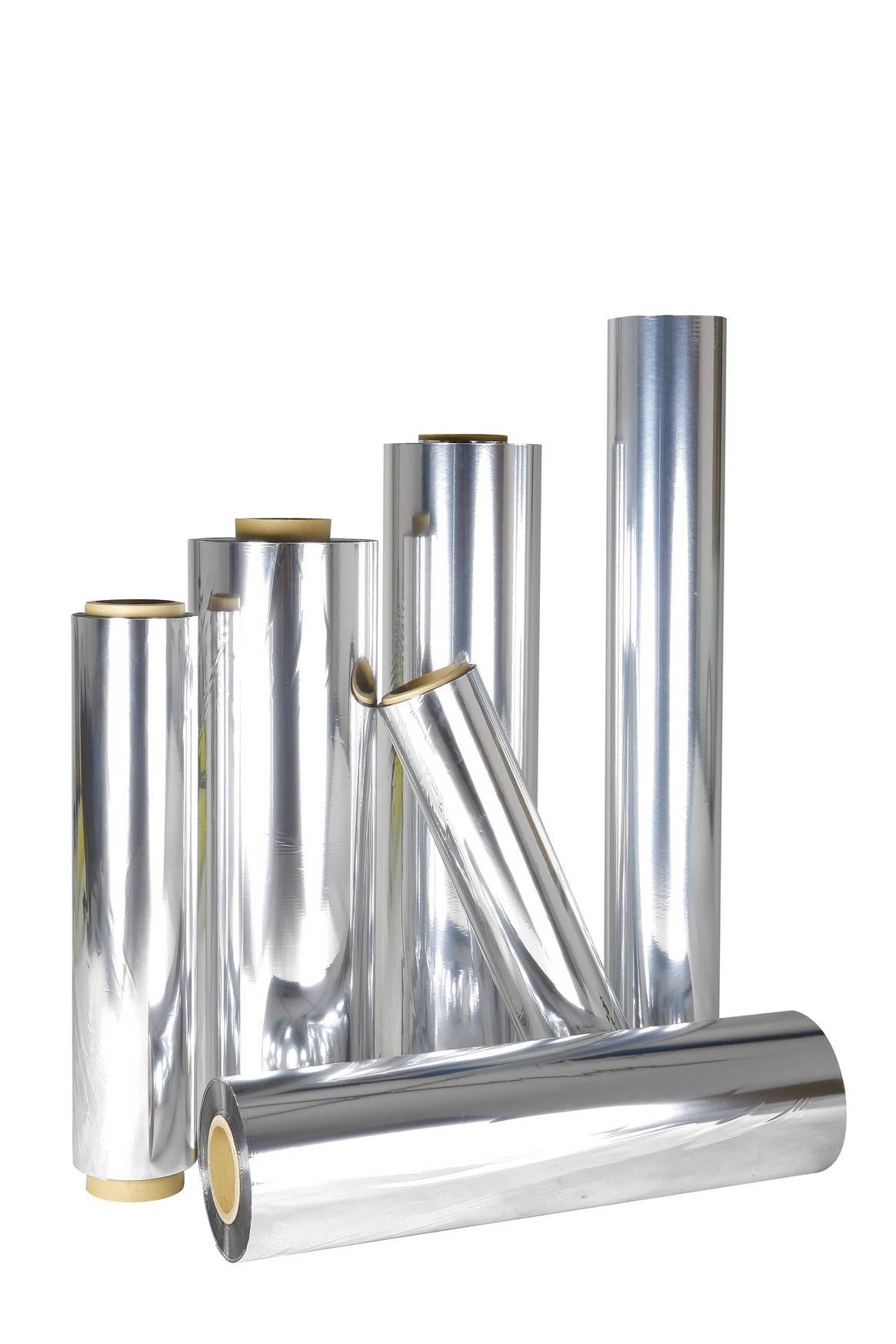
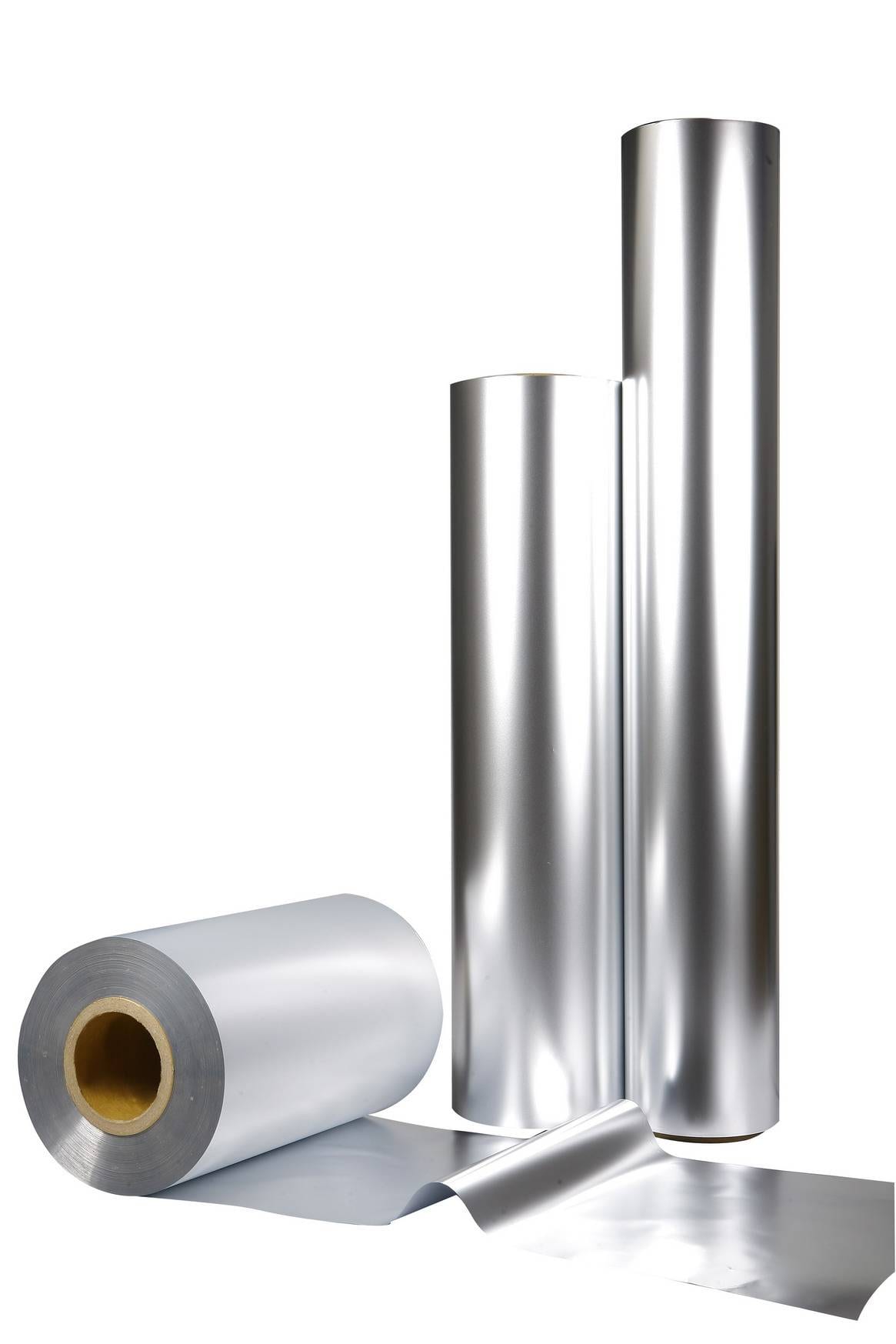
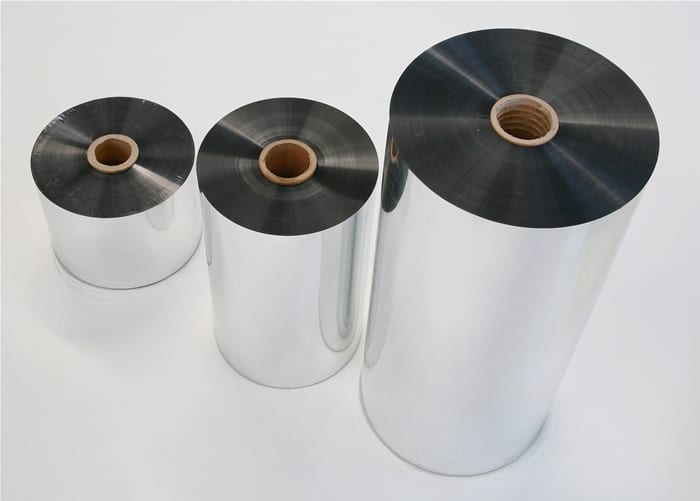
Metallized roll stock
What actually decides the barrier: optical density
Ask three suppliers how thick their aluminium layer is and you will get three answers that cannot be compared. Nanometres of aluminium are difficult to measure directly on a finished roll, so the figure quoted is usually a machine set-point rather than a measurement of the product.
Optical density (OD) is the number that can be measured, and it is the one worth asking for. It is a spectrophotometric reading of how much light the aluminium layer stops. Higher OD means more aluminium deposited, and — up to a point — better barrier.
The relationship is not linear, which is the part buyers tend to miss. Barrier improves quickly as OD rises through the lower range, then flattens. Past that point you are adding aluminium for appearance rather than performance: the roll costs more and the shelf life does not move. Two films quoted at different OD values can perform identically in a pack, and two films at the same nominal OD from different lines may not.
That is why we quote an OD range alongside the substrate rather than a single layer thickness, and why the WVTR table above names the substrate and gauge for every row.
Adhesion is the failure nobody tests for
Metallized film or aluminium foil
This is the comparison buyers ask for most often. The honest answer is that the two are not competitors at the top end.
| Metallized film | Aluminium foil | |
|---|---|---|
| Barrier ceiling | High, but finite | Effectively absolute at 9 µm |
| Weight and cost | A fraction of foil | Highest of the barrier options |
| Flex and pinhole resistance | Good on a compliant base | Poor — pin-holes under repeated flexing |
| Appearance | Metallic, can be printed over | Opaque, no print-through |
| End of life | Same polymer family as the base | Multi-material in almost every structure |
Specify foil when the shelf life is measured in years, when the contents are genuinely oxygen-critical, or when the pack must be absolutely light-proof. Nine microns of aluminium transmits effectively nothing, and no metallized layer matches it.
Specify metallized when the shelf life is months rather than years, when the pack has to survive handling without pinholing, and when weight and cost are part of the brief. In most snack, confectionery and dry-goods formats, metallized now does the job foil used to do.
One case that catches people out: a foil laminate that passes on flat film can still fail at a gusset, because foil is the least forgiving of the barrier options under repeated flexing. If your current pack is a foil stand-up pouch and it is failing in the field, the answer is often a thicker metallized structure rather than more foil.
Where metallized films are specified
| Application | Typical structure | Why metallized |
|---|---|---|
| Snacks and savoury | VMPET / PE or VMCPP inner web | Moisture barrier at high speed |
| Coffee and dry powders | VMPET / PE | Aroma retention plus oxygen barrier |
| Confectionery | VMPET / VMCPP | Light and moisture barrier, print quality |
| Labels and surface decoration | VMPET | Metallized appearance without foil cost |
| Washing-machine and appliance labels | VMPET | Moisture and chemical resistance |
| Mono-material packs | VMPE / PE | Barrier plus recyclability |
Beyond packaging: transfer films
If you are not a flexible-packaging converter but still need a metallic finish, OLUNRO supplies metallic transfer films used in clothing and accessories, and in residential and commercial construction. Different converting route, same metallizing capability.
Why buyers shortlist OLUNRO
Request a metallized film sample
Send us your structure, your barrier target and your converting route. We come back with a recommended specification and a trial roll.